
Operational execution platform
The operating layer between your procedures and your people.
One structure holds the procedure, the facts of this operation, the tasks, the owners, the timing, who gets told what, and everything that happened.
LiveSOP, the Evolution of Operations.
Who runs it
Built for the person who gets called when it goes wrong.
Preparation
The work is not building the operation. It is preparing for it.
Everything LiveSOP™ does at speed is paid for in advance. Templates carry the sequence and the rules; your vendors, sites, vehicles and people are described once. By the time something happens, the platform already knows what your organization considers a valid answer.
Prepared once
- Procedure templates, versioned
- Roles, sequence and timing
- Notification and visibility rules
- Approved vendors, sites and assets
- People, teams and who deputizes for whom
So activation is this short
- Template Executive arrival
- Principal R. Okonjo
- Location Panama City
- Operations lead M. Reyes
Four selections, and the tasks, owners, timings, map and rules are in place. You decided all of it in advance.
Preparation becomes execution.
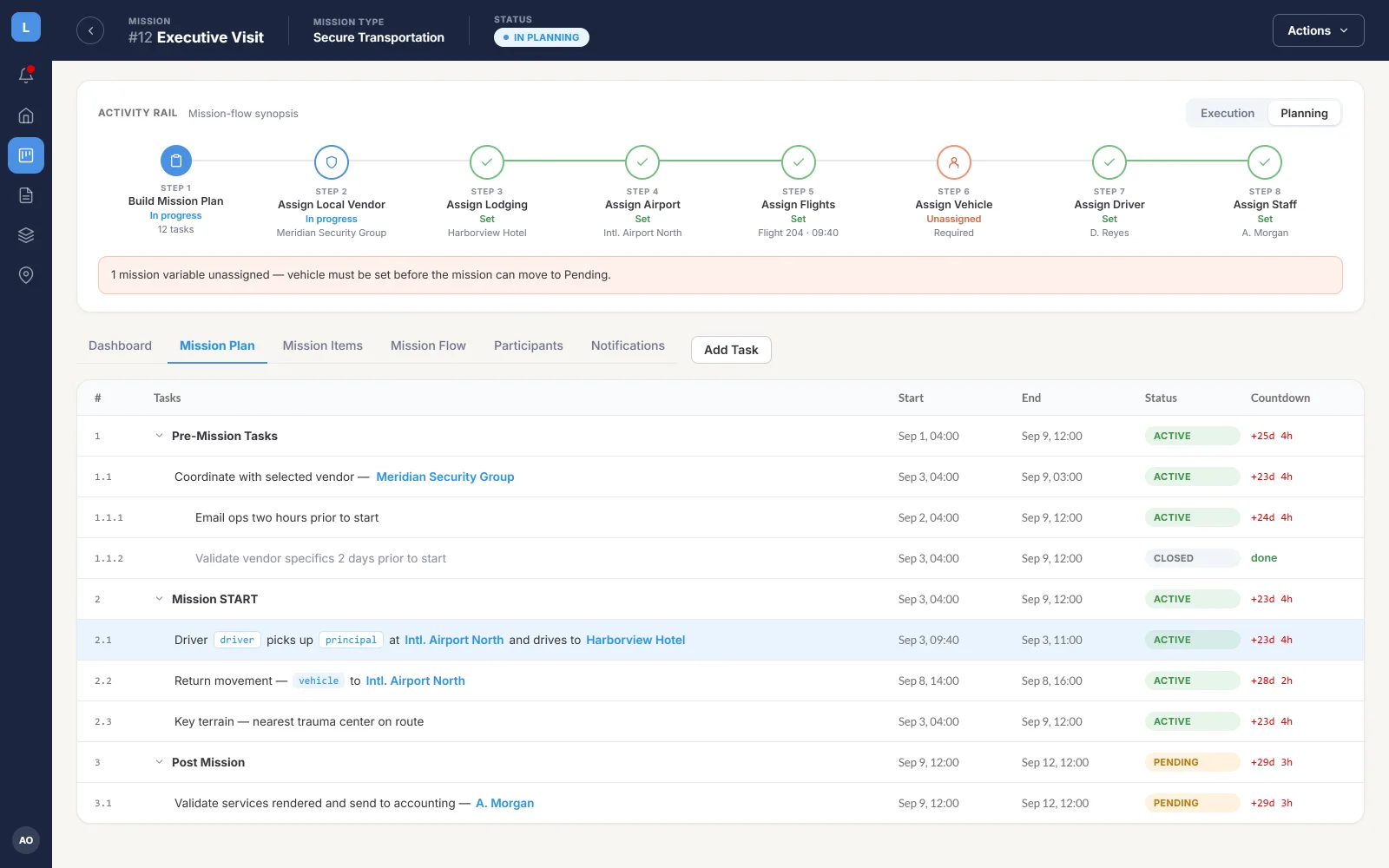
The mission model
Five parts, each removing a specific way operations fail.
Systems provide the facts.
The procedure provides the rules.
LiveSOP connects them during execution.
Procedure templates
Your best operator’s knowledge stops leaving with them
Order, roles, timing and notification rules live in a versioned template. Improve it once; every mission after inherits it.
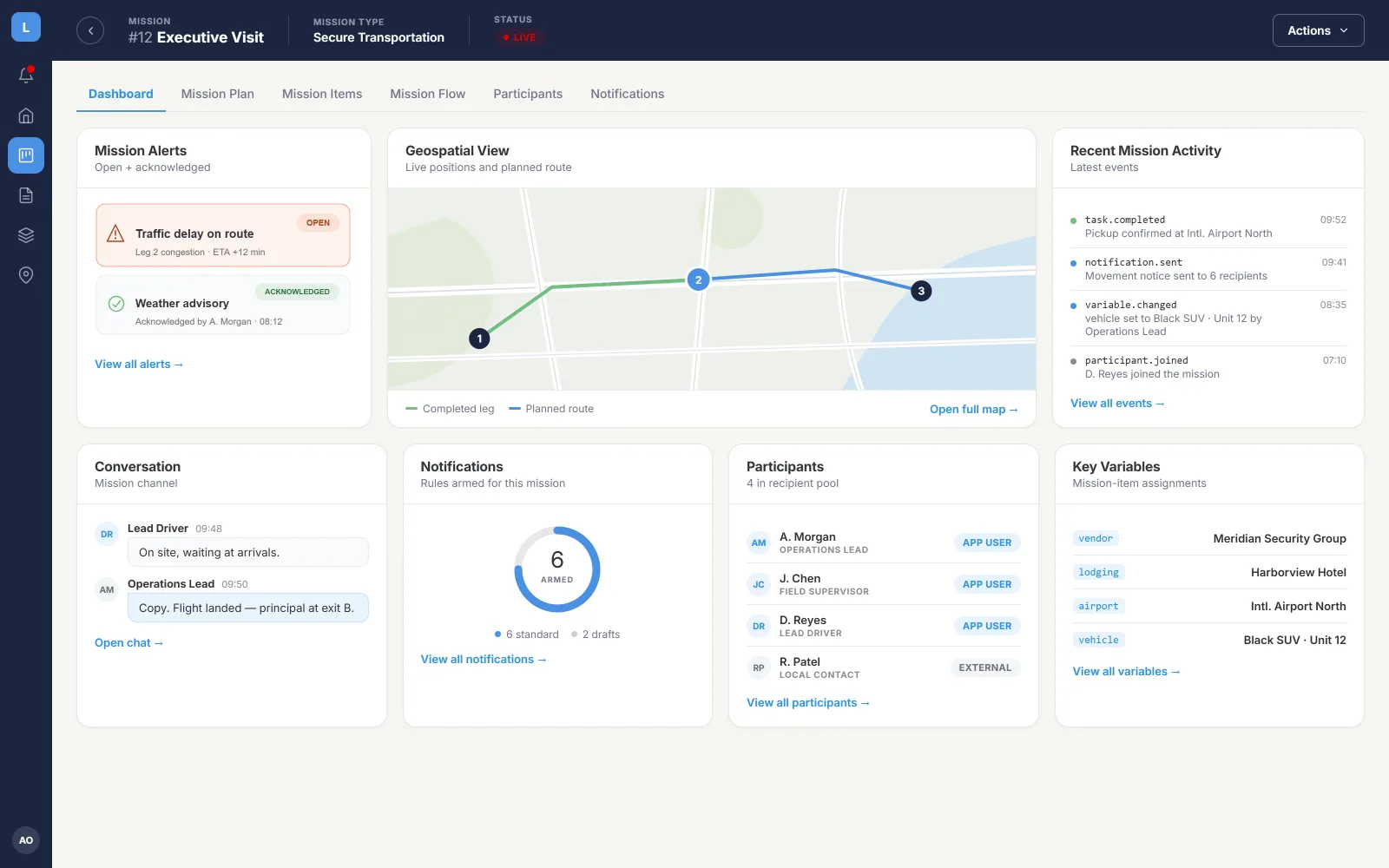
Notification and visibility rules
Who gets told what, decided before the pressure starts.
Deciding who needs to know is the work that gets skipped under pressure. Here it is part of the procedure: a plain sentence anyone can check, attached to a trigger.
Ownership
Ownership is a property of the mission, not the last thing someone said on a call.
Every participant can answer
- What needs to happen
- Who owns it
- When it is due
- What is most urgent right now
- What has been completed
- What is blocked, and on what
- What is at risk of being missed
Confirm alternate route with local contact
Owner
J. Alvarez
Due
15:40
Priority
High
Blocks
Tasks 08, 09
The task exists because a procedure said it must, it is bound to the mission’s facts, and it blocks named work downstream.
During and after the mission
The Activity Rail is the operation telling its own story.
Assignments, field confirmations, changes and decisions join the rail as they happen — readable mid-operation, and finished the moment the mission closes.
Mid-operation handover. Whoever joins reads the rail and is current, without a catch-up call.
After-action review. Walk the mission in order and see where time was actually lost.
Evidence. Show that the procedure was followed, with owners and timings attached.
Template change. Fix the step that failed, once, where every future mission will pick it up.
LiveSOP is built and supported by Compass Island, which builds software for organizations that have to operate under changing conditions.
Our sister product CI360 handles awareness — knowing what is happening. LiveSOP handles what comes after that: knowing what to do next, and making sure it gets done.
The parts only make sense running.
On a page these are architecture. Watch them absorb a change mid-operation and it becomes obvious what each one is for.