
Operational execution by industry
The industry changes. The failure does not.
A guard post, a helibase and a stadium look nothing alike, and their procedures break in exactly the same place: between the document and the ten people who have to carry it out at once.
Six markets, one operating model.
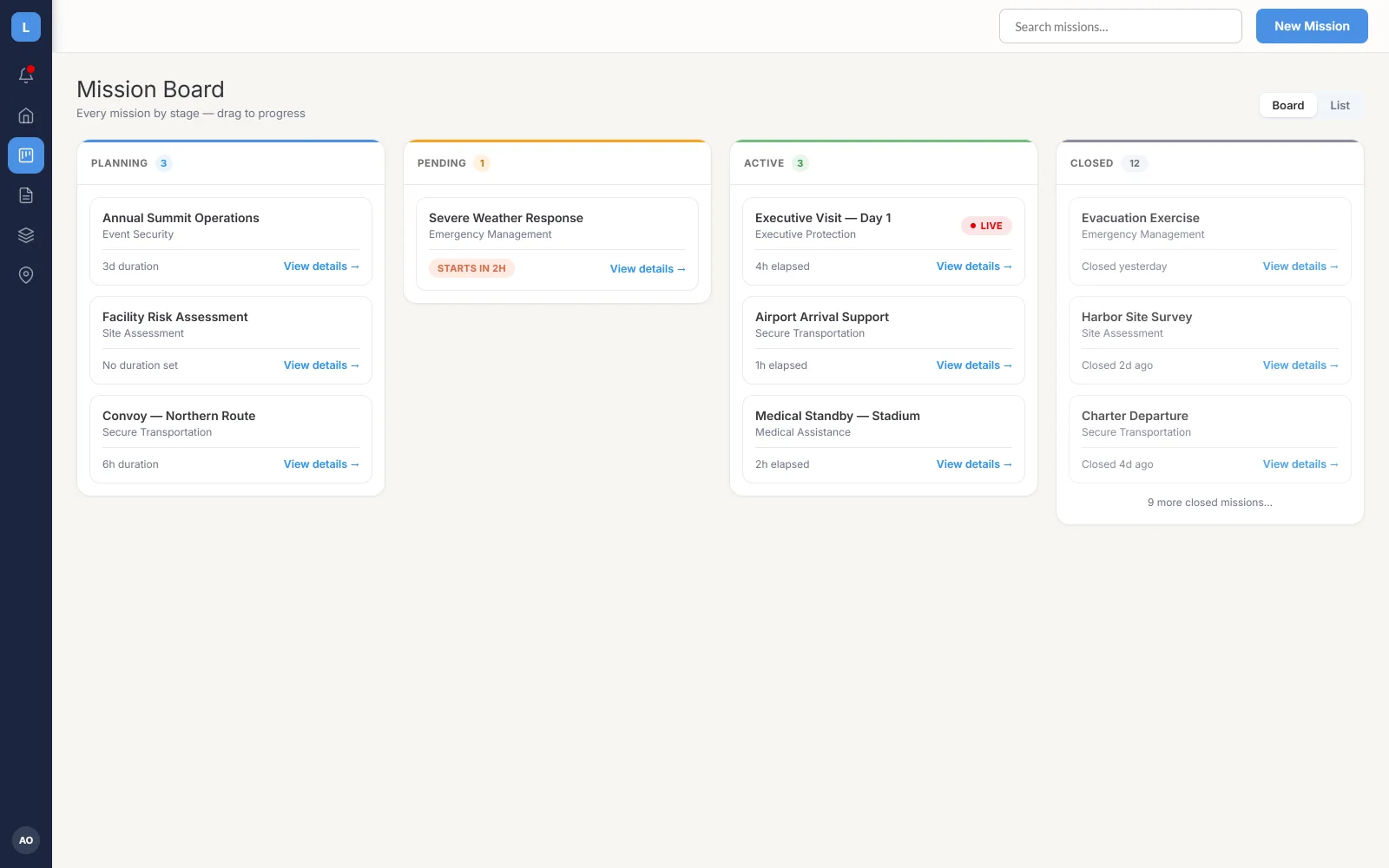
Missions like a principal arriving in an unfamiliar city, a threat to a facility, or a workforce to account for after an incident abroad.
- Today
- The plan lives in the duty officer’s head, and on the phone.
- With LiveSOP™
- The escalation procedure runs as a mission with named owners, so an incoming shift inherits the operation instead of reconstructing it.
Fewer steps missed, fewer handoffs dropped, and clear accountability for every one of them — during the incident, not in the review afterwards.
Missions like a twice-daily turnover across every post under contract, a call-out an hour before shift, or an officer whose credential lapsed overnight.
- Today
- Turnover is a paper log and a phone call, and the gap is found the next morning.
- With LiveSOP™
- The turnover runs as a procedure with evidence attached to each step, and the rules catch an unfilled post or a lapsed credential before the shift starts.
Coverage you can prove to the client, and SLA credits you never had to pay.
Missions like qualifying a new customer to receive product, monitoring the credentials already on an account, or an order that cannot ship as written.
- Today
- An analyst works the document list from memory, and a lapse is found when an order holds.
- With LiveSOP™
- The requirement set is derived from what is being bought and where it ships, and every credential carries a countdown.
A file that is current on its own, and a record retained without anyone assembling it.
Missions like a resource order that has to launch inside the hour, a restriction published over the working area, or a reassignment that would break a limit.
- Today
- Three phone calls and a card binder to clear one aircraft.
- With LiveSOP™
- Every list is filtered to what is legal for this order — carded, contracted, inside duty and rest — so what you can see is what you can launch.
Faster launch, and a limit that is enforced before the aircraft is committed rather than after.
Missions like standing up an activation when a threshold is crossed, a county request that needs a state mission number, or a surge the region cannot absorb.
- Today
- The plan is a binder, and escalation is argued about while a county waits on the phone.
- With LiveSOP™
- The activation runs across the desks you already staff, with escalation settled before the event rather than during it.
A county that has a tracking number in minutes, and an after-action report that is an export rather than a reconstruction.
Missions like a load-in schedule that every vendor depends on, a gate that has to open on time, or a weather call that moves everything after it.
- Today
- A run of show in a spreadsheet, and radios to hold it together on the day.
- With LiveSOP™
- The run of show is a live mission: each cue owned and timed, and a change to the doors time moves everything downstream with it.
One schedule everybody is actually working from, and a record of what happened while it happened.
Not on this page? The only question is whether people execute it together.
If people, timing and consequences are involved, the operating model already fits. The industry label was never the hard part.